2003 International School Bus Dash Buttons What Do They Do
There's plenty of stress driving a school bus route. Seeing a dash lamp suddenly come on while in the middle of a route can amplify that stress greatly—especially if the driver isn't sure exactly what the lamp means, or what action needs to be taken.
Here's what school bus operators need to know.
The color of the lamp generally is a good indicator of the severity of the issue—if it is amber in tone, it's most often a maintenance item to be serviced at the first available opportunity. A red lamp lets the driver know that there's a serious issue that needs immediate attention. In addition, some lamps (like those for the aftertreatment system) will flash as an alert that service is needed soon and then stay on continuously when it becomes an immediate issue that needs to be resolved.
Here is a quick overview of these dash lamps, by category:
General Engine Indicator Lamps
On-Board Diagnostics Lamps
On-board diagnostics have been included since 2013 to help ensure that emissions controls are operating properly.
- The Malfunction Indicator Lamp shows an amber engine silhouette (NOTE: there is no wrench inside it.) The operator should report this to dispatch for diagnosis and service at the next opportunity.

- When the Malfunction Indicator Lamp and the Stop Engine Lamp come on at the same time, the bus should be stopped as soon as safely possible for immediate attention at an authorized Cummins location.

Diesel Exhaust Fluid (DEF) Lamp
DEF is a specific concentration of urea and water that is essential for the Selective Catalytic Reduction (SCR) system to clean the exhaust so that only harmless nitrogen gas and water vapor are emitted. The DEF Lamp will illuminate by itself—or along with the General Engine Indicator Lamps—as an alert to the bus operator.
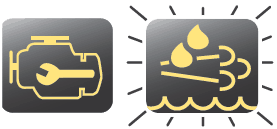
- A Stop Engine Lamp (red stop sign) along with a flashing DEF Lamp and a solid Check Engine Lamp is an indicator that the DEF level is critically low, and the vehicle has been fueled without refilling the DEF tank.
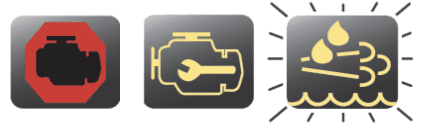
- It can also be an indication that the engine has been idling for an hour or been shut down without any corrective action being taken. Refilling the DEF tank with the correct type of DEF fluid will resolve the issue.
If for any reason, the DEF lamp stays on after reloading the DEF tank with the correct fluid, service will need to be scheduled immediately.
Diesel Particulate Filter (DPF) Lamps
These lamps indicate that either a passive regeneration is taking place or active regeneration is needed. Passive regeneration happens as a normal action during the course of driving. Active regeneration is needed when there is not enough heat in the exhaust system to burn off the Particulate Matter (PM) that collects inside the Diesel Oxidation Catalyst (DOC).
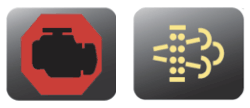
- When the DPF Lamp AND the Stop Engine Lamp are illuminated, the soot load has become too much for regeneration to handle. The vehicle will need to be taken to an authorized Cummins location for repair.
Conclusion
In general, these warning lamps are no different than a low-fuel lamp or a low tire-pressure indicator. They simply provide key information to your bus operators about the status of critical systems. Knowing what they mean—and how to respond—helps to remove unnecessary stress from your school bus operators' jobs and keeps your fleet operating cleanly and reliably for years to come.
For additional information about the regeneration process, how to perform a parked (stationary) regeneration, a more detailed explanation of exhaust aftertreatment functions and an in-depth review of Selective Catalytic Reduction and DEF composition, please visit cummins.com.
2003 International School Bus Dash Buttons What Do They Do
Source: https://stnonline.com/partner-updates/school-bus-dash-lamps-why-they-turn-on-and-what-turns-them-off/
0 Response to "2003 International School Bus Dash Buttons What Do They Do"
Post a Comment